
Lutyens’ Mughal Gardens
Today we visited the sumptuous Mughal Gardens that lie behind the President’s Palace (Rashtrapati Bhavan) in New Delhi. Normally private, the gardens are opened free of charge to the public for just a few weeks every February and March, when flowering in the gardens is at its peak. [Sadly, for security reasons, cameras are not allowed, so I am using images from other sources for this post.]

Aerial view of the main part of the Mughal Gardens, with the palace in the background. Image from India Perspectives Vol 24.
A successful mix of Indian and European influences, the fifteen acres of gardens were laid out by Edwin Lutyens, the British architect who designed the palace itself and much of the surrounding colonial city of New Delhi in the 1920s and 30s.
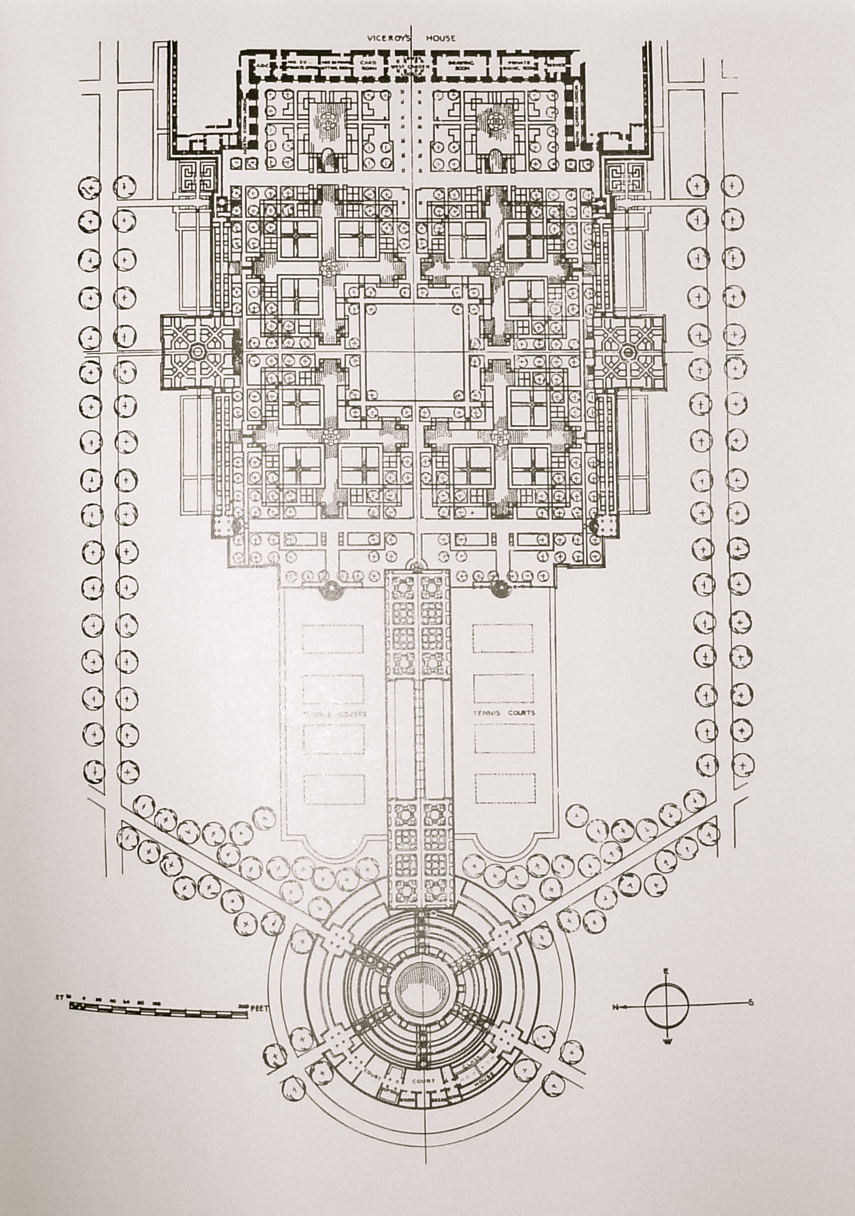
Plan of the Mughal Gardens, from Irving, Indian Summer.
As this plan shows, the gardens divide into three areas: first, the grand section immediately behind the palace with its lotus fountains and spectacular stepped geometry. At the other (western) end, there is a more private butterfly garden around a gentle circular pool and, joining these two together, is a long narrow walled garden, edged on both sides by tennis courts, and planted with roses and bougainvillea.
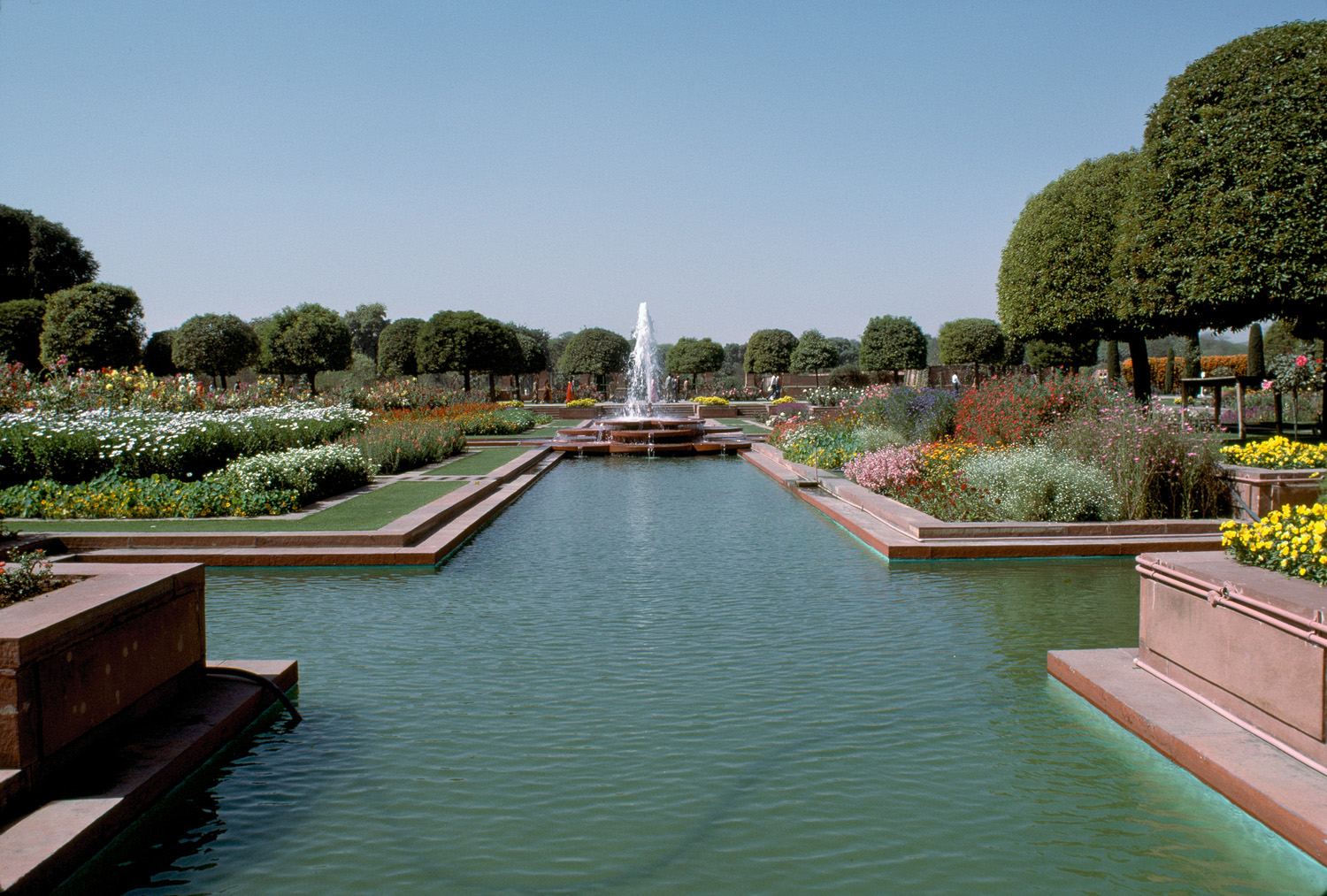
Lotus fountain and flower beds in the main garden, January 2010, from the Aga Khan Visual Archive.

The circular pool, in January 2010, from the Aga Khan Visual Archive.
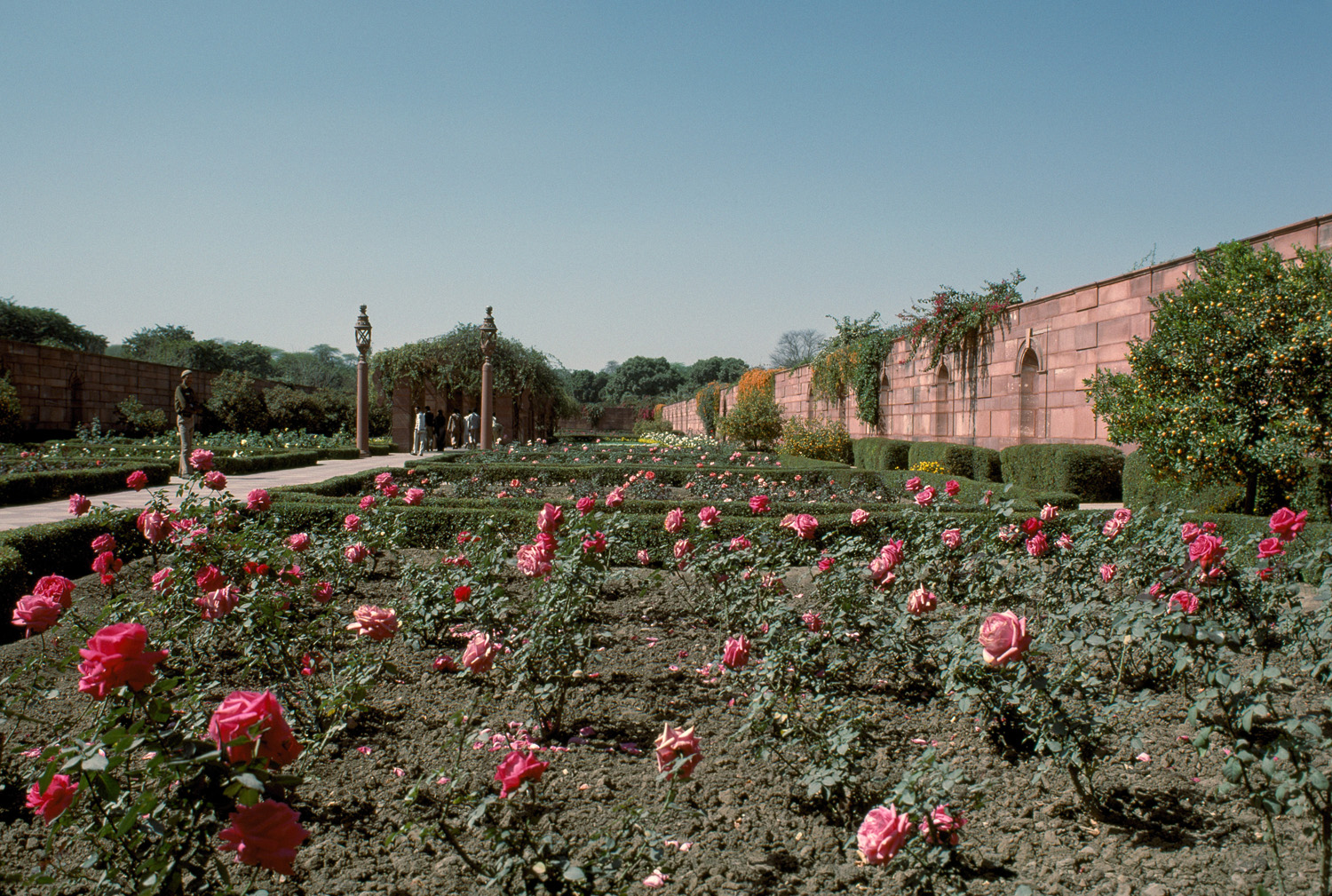
Pergola and rose beds in the narrow walled garden, from the Aga Khan Visual Archive.
Lutyens was famously not a fan of Indian architecture (or indeed of Indians). He described the former as “cumbrous, ill-constructed… the building style of children” and dismissed the latter as “odd people with odd names.” With such views commonly held, Lutyens and the other Brits involved in the creation of New Delhi debated how far Indian influences should be reflected in the design of their colonial capital. For the palace gardens and other landscape features, the issue was coloured by two important books published during the time New Delhi was being built, and both probably deliberately seeking to influence the debate in favour of traditional Mughal elements: first, Constance Mary Villiers Stuart’s Gardens of the Great Mughals, published in 1913; and second, Indian Gardens [Indische Gärten], also by a woman, Marie Luise Gothein, which appeared in 1926. Certainly Lutyens’ original plans for an artlessly planted English-style garden behind the palace were to change dramatically.
The plan he finally produced for the site, inspired by gardens he had visited in Agra and Kashmir, reflected the pleasing geometry and balance of Mughal gardens, their beautiful stonework, and the plentiful use of water in rills and fountains to divide the gardens into quadrilateral patterns. These ideas were to some extent a natural progression for Lutyens from the arts and crafts style he had established in his English designs, such as the delightful garden at Hestercombe in Somerset. To these Mughal influences at the palace gardens Lutyens added two very British lawns designed for entertaining, and many large geometric flower beds usually described as English in style (although originally many Mughal gardens would have had similar masses of colourful flowers). To provide year-round structure among the flowers, the main garden is punctuated by clipped specimens of the fragrant native maulsari tree (Mimusops elengi) and by columnar cypress.

An aerial image of the palace shortly after it was completed, showing the new gardens in the foreground, as part of the grand axis along which New Delhi was being constructed. Image from the Centre for South Asian Studies, University of Cambridge.
British garden historian Tom Turner (whose wry blog at Garden Visit I highly recommend) has been critical in the past of these gardens. In an article in 2005 in Historic Gardens Review, he wrote disparagingly of the inappropriately coloured tiles in the pools, the spotty old-fashioned planting and the poor standard of maintenance, citing leaking basins and obtrusive plant supports.
Many of these issues seem to me to have improved since 2005. Today I saw no sign of leaks and very few plant supports, and the flowers, while traditional in choice, were spectacular in colour and range (although the pool tiles did perhaps still have something of the swimming pool about them).
My one big criticism of these gardens would be that, apart from the sandstone pergola in the long walled garden, there is a decided lack of shade. The trees in the main garden are too fastigiate or too clipped to provide any meaningful shadows, and elsewhere there are only low flowerbeds and lawn. Even today, before the Indian summer has really begun, it was too hot to linger for long among the garden’s delightful fountains, flowers and intricate geometric patterning.

The shade-giving pergola in the walled garden. Image from Irving, Indian Summer.
16 comments on “Lutyens’ Mughal Gardens”
Leave a comment
Recent Comments


Discover other landscape lover articles on these sites:


 a landscape lover's blog
I must say these are magnificent in their size and grandeur…I canot even imagine planning or building something on this scale…I think it is lovely…
Thanks for the comment. Lutyens was hailed in his day as the greatest British architect since Sir Christopher Wren, but nowadays lots of people are rather sniffy about him. Certainly the commonly held view is that his only decent garden designs are the ones he produced with Gertrude Jekyll. Yet, as you say, these gardens in Delhi have a confident majesty and scale that very few designers could produce and, for all Lutyens’ derogatory remarks about India and its people, he managed to produce something here that triumphantly draws together Mughal and European influences into a garden perfectly suited to a British palace in colonial India.
Too hot to linger? but there must be a team of hard working gardeners, despite the fierce heat. Is the garden used for official entertaining?
Yes the poor gardeners were busy while we were there yesterday, watering and mowing, sweeping and deadheading. I suspect in the hotter months they work early in the morning and again in the evening. I believe the garden is used extensively for entertaining and I bet that the current Indian President, like the Mughals before her, uses temporary marquees and awnings to keep the worst of the sun off her guests.
The rills of water really soothe the eye, and I’m glad that component of elegant Mughal design was included.
Your own excellent photos would doubtlessly captured more of the atmospheric qualitles of the garden; the archive photos give me the feeling of expanse and glare and, as mentioned, intense heat.
I’m with you on the shade issue. Many of the garden vistas could be enjoyed from the shade of well-placed, spreading trees or architectural shade structures.
When Lutyens was designing, was integrating shade for visitors and entertaining considered, do you know? Or was the garden’s visual and geometric order primary?
Thanks for suggesting that my photos would better explore the character of the garden! Certainly I couldn’t find any images that captured the lushness and colour of what we saw. But it is pretty open and exposed.
I’m trying to find out more about Lutyens thinking when he designed this. The Brits used to decamp to Simla in the Himalayan foothills to avoid the worst of the Delhi summer, so maybe he didn’t worry too much about providing shade in the hottest months?
Do you know why Lutyens has fallen out of favor, Jill? I must admit, I know him primarily through his benches… Also, could shade be a security concern?
I think his era has become so unfashionable – he built country houses in England for rich Edwardians and then an imperial capital in Delhi for the Raj. After the Second World War (Lutyens died in 1944), such architecture seemed elitist and irrelevant. In stark contrast, the new Indian Prime Minister commissioned Le Corbusier to design the state capital Chandigarh while, in Britain, the desperate need for post-war reconstruction led to a focus on cheap pre-fabricated social housing and then the futurist architecture of the 1951 Festival of Britain.
As I said to Maggie above, I’m investigating the whole issue of (lack of) shade at the Mughal Gardens further, and hope to report back.
Thanks for this article! I am planning to visit the Mughal gardens soon and your post was a great read before my trip.
Thanks for stopping by. The gardens are absolutely worth a visit. They’re open until 15 March, and then not again until February 2013.
Thank you for that wonderful post! Seeing the gardens of the Rashtrapati Bhavan is pretty much at the top of my bucket list, since so far I have never had the chance to visit India in winter. Maybe a few years down the line I will be able to time my academic field work so that it will put me in Delhi in February/March…
Thanks for the comment. February is the perfect month to visit Delhi – it is reliably warm and sunny and dry every single day (around 25C / 77F); the murky fog of January has gone and the heat of the summer is still a few weeks away…
Ah those were the days! Delightful blog. Cheers Billy
Wow that is simply beautiful! You have to think who the architect and designer if this wonder was thinking when he did it….This requires such love and passion for this trade…It simply is beautiful!
Thank you for this interesting, helpful entry. Please allow me the opportunity of promote my own blog, detailing what Lutyens did and did not do with the landscaping at the British Embassy, here in Washington:
http://washingtonembassygardens.wordpress.com/
Thanks for the link. I had not realised that Lutyens was working on both projects at around the same time. Your blog is a great resource for anyone interested in Lutyens’ work abroad.